





Why Is Battery Production a Strategic Technology Area?
Today, energy storage technologies have ceased to be merely components of electronic devices and have become the core backbone of many sectors, from automotive to renewable energy systems, and from industrial infrastructures to mobile power solutions. The proliferation of electric vehicles, the growth of renewable energy sources such as solar and wind, and the diversification of portable devices have made battery manufacturing processes a strategic field on a global scale.
Especially with the development of lithium-based technologies, battery manufacturing is no longer just a mechanical assembly process, but a combination of chemical, electronic, and automation processes requiring high precision. The performance of a battery is the result of many different stages, from the quality of the cells used to balancing on the production line, and from BMS software to quality control testing. Therefore, modern battery manufacturing is a process requiring advanced engineering and high technology.
In Turkey as well, interest in battery technologies is rising, particularly with the increasing need for energy storage. More reliable and long-lasting production processes are coming to the forefront for batteries used in solar energy systems, caravan solutions, and industrial applications.
What Is Battery Production?
Battery production is the process of designing, assembling, and turning cells that enable the storage of electrical energy as chemical energy into a safe system. This process is not limited to cell manufacturing alone; it also encompasses protection circuits, software management, and safety tests.
A battery basically consists of anode, cathode, electrolyte, and separator layers. Combining these components in correct proportions and under controlled conditions directly affects the performance of the battery. This precision is much more critical, especially in Lithium-based (LiFePO₄, NMC, etc.) technologies.
The goal during battery manufacturing is not only to store energy, but also to create a safe, long-lasting, and stably operating system. Therefore, the production process has a multi-layered structure.
Fundamental Stages of the Battery Manufacturing Process:
A. Cell Manufacturing
1. Cell Assembly & Filling
In this stage, the prepared anode and cathode strips are wound into a roll or stacked on top of each other according to the casing type, with thin ion-permeable separator layers placed between them. As a final step, liquid electrolyte, which will enable ion movement, is injected under high vacuum into the cells whose mechanical assembly and cover welding are completed, and the cells are sealed airtight. To prevent micron-level dust or moisture from causing a short circuit in the battery, this process is carried out in completely dust-free (cleanroom) and very dry (dryroom) environments using highly automated machines.
2. Cell Formation & Aging
The cells whose electrolyte filling is completed and which are kept for a certain period to absorb the liquid completely (wetting) are taken into a vital activation process called “Formation”. The cells are charged and discharged for the first time with very precise current and voltage profiles to form a protective chemical layer called SEI (Solid Electrolyte Interphase) on the electrode surfaces. This layer determines the lifespan and safety of the battery.
3. Grading & Sorting
Cells that have completed activation are kept at room temperature and high temperature for days (aging) to monitor voltage drops; those with microscopic leaks are eliminated. At the end of the tests, the actual capacity and internal resistance (IR) of each cell are measured, and cells that match each other perfectly at the millivolt and milliampere level (Grade A) are grouped.
B. Battery Pack Assembly
1. Packaging and Module Assembly:
After cell-based production and tests are completed, cells are brought together according to the project’s architecture to form battery packs. At this stage, cells are connected to each other in series (S) and parallel (P) configurations to reach the voltage and current values required by the target application (e.g., 12V, 48V, or 51.2V ESS systems).
During the packaging process, special holders that ensure the cells remain vibration-free together are used, and electrical conduction is provided via busbars resistant to high currents. The most critical parameter at this stage is the matching of cells with each other. If cells with matching capacity, voltage, and internal resistance values (cell matching) are not used in battery production, imbalance in system performance, uncontrolled inter-cell currents, and premature aging occur.
For your specialized battery demands, please visit https://birikimpilleri.com/en/solution/customized-battery-manufacturing/
2. BMS (Battery Management System) Integration:
In modern battery engineering, the brain and protective shield of the system is the electronic control unit called BMS (Battery Management System). Integrated into the battery at the packaging stage, the BMS monitors the voltage of each cell series, the instantaneous current drawn, and the temperatures at different points of the pack at the millisecond level.
Thanks to advanced BMS software and hardware;
- Over-charging (Over-Voltage) and over-discharging (Under-Voltage) of cells are prevented.
- Heating curves of the batteries are controlled by performing thermal management (temperature control).
- In cases of short circuit and over-current (Over-Current), the system is cut off within split seconds.
- Voltage differences between cells are equalized with cell balancing algorithms.
Especially in LiFePO₄ (Lithium Iron Phosphate) battery technologies where the voltage curve is quite flat, an advanced BMS integration is an absolute necessity to make accurate SOC (State of Charge) estimation and ensure system safety.
You can get more informations via https://birikimpilleri.com/en/solution/battery-engineering/
3. Quality Control and End-of-Line Testing Processes (End-of-Line Tests)
Battery packs whose assembly and wiring are completed are subjected to final quality control and testing processes called EOL (End-of-Line) before being shipped to the customer. These tests, which simulate the battery’s behavior in actual field conditions, include the following:
- Capacity and Load Tests: It is measured whether the battery delivers its promised Ah capacity fully and its voltage drops (DCIR) under nominal/maximum load currents.
- BMS Function Verification: Whether the BMS’s over-current, short-circuit, and temperature protection limits work correctly is tested by software simulation.
- Insulation and Sealing (Hipot/IP) Tests: It is checked whether there is any leakage to the chassis under high voltage, and outer casing tightness (IP standard) is verified.
- Communication Tests: Communication protocols (CANbus / RS485) that allow the battery to communicate with the inverter, caravan system, or vehicle computer are tested.
Batteries that successfully pass these end-of-line tests are certified with a guarantee of safe and long-lasting operation and become ready for use.
Rise of LiFePO₄ (Lithium Iron Phosphate) Battery Technology
In recent years, the electrochemical model that stands out the most in the global battery industry and clean energy transformation is LiFePO₄ (Lithium Iron Phosphate) technology. This technology dominates the market with advantages of superior structural safety, extraordinary cycle life, and high thermal stability compared to conventional lithium-ion (NMC/LCO) batteries.
LiFePO₄ batteries do not release oxygen even at very high temperatures thanks to the strong covalent bonds in their molecular structure; this minimizes thermal runaway and fire risk. Capable of withstanding between 3,000 and 6,000 full charge-discharge cycles (100% DoD) depending on cell quality, this technology has become standard primarily in solar energy storage systems (ESS), caravan house batteries, electric vehicles (EV), and military/industrial power solutions. Furthermore, not containing conflict and expensive metals such as cobalt and nickel in raw material supply provides both a cost advantage and sustainable quality consistency in mass production.
Automation and Industry 4.0 Impact in Battery Manufacturing
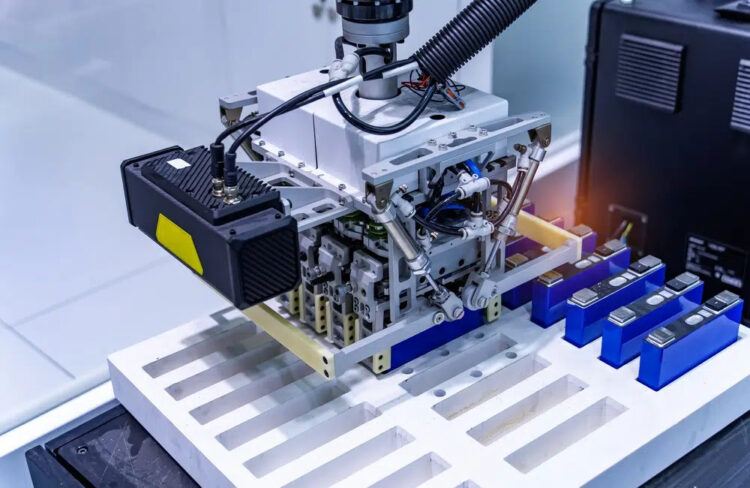
Modern battery production relies on advanced automation systems stripped of human initiative due to micron-level precision requirements. AGVs (Automated Guided Vehicles), robotic cell assembly lines, and artificial intelligence (AI) supported automated optical inspection (AOI) systems form the core of modern smart factories (Smart Factory).
Thanks to these technologies, production tolerances at the millivolt and milliampere level are managed without error, minimizing scrap rates and maximizing production speed and energy efficiency. Thanks to Industry 4.0 architecture, a “Digital Twin” and a unique QR code/serial number are assigned to each cell from the raw material stage to the finished pack level. In this way, full backward traceability is provided, enabling the identification of which production batch even the slightest anomaly in the field originates from within seconds.